Dr. George Hevesy was voted out as Chairman of the Emergency Department at OSF in Peoria.
There are about thirty attending physicians who work in the ED now and their vote several months ago was not even close. Dr. Dick Frederick became the new Chairman.
Dr. Hevesy is still the Director of the Emergency Department. This is an appointed position by OSF Administration. So Keith Steffen, CEO at OSF, still supports George even though George's fellow colleagues overwhelmingly do not. This vote of no confidence in George was a long time coming. However, as I have documented many times in this blog and in Peoria's Medical Mafia, fear plays a big role in how things are done at OSF.
There were many reasons why George fell from his position. The Sisters have been protected from knowing too much about their own hospital, which is a shame. I think OSF Administration knows much about the concept of "plausible deniability" and understands how to use it effectively to keep the Sisters in the dark.
Dr. Hevesy is no longer EMS Director at OSF, but due to the fact that he is still Director of the ED, he controls the physician who is EMS Medical Director in his department. Peoria Area EMS, based at OSF, has about 60 agencies which they control. Advanced Medical Transport (AMT) is one of these agencies. And AMT is the only paramedic/transport agency in Peoria. Dr. Hevesy still receives a handsome salary from AMT and from OSF.
It won't be long before Dr. Hevesy is no longer Director of the ED at OSF. His utility at OSF is diminishing.
Keith Steffen, CEO at OSF, doesn't have much time left at OSF either. Keith, my unsolicited advice for you is to ditch George as Emergency Department Director while you still have the chance. No one will think worse of you...
In my opinion if Peorians knew the real details at our Catholic hospital both men would have been gone long ago.
Sunday, November 27, 2011

Saturday, November 19, 2011
Doing the Ethical Thing

Photo by John Carroll
From the New York Times--November 19, 2011:
Here’s another way we deceive ourselves. Most of us say we admire people who stand up for what’s right (or what is eventually shown to be right), especially when they are strong enough to stick to their guns in the face of strenuous opposition.
But again, research shows that’s not necessarily true. In “When Groups are Wrong and Deviants are Right,” published last year in The European Journal of Social Psychology, Australian academics argue that group members are often hostile to people who buck conformity, even if the members later agree with the dissenter.
Even when, say, a whistle-blower may prove to be correct, she is not always admired or accepted back into the fold, the academics found. Rather, the group may still feel angry that the whistle-blower damaged its cohesion.
Philip G. Zimbardo, professor emeritus of psychology at Stanford University and author of numerous books including, “The Lucifer Effect: Understanding How Good People Turn Evil” (Random House, 2007), has spent a lifetime studying moral degradation. In 1971, Professor Zimbardo set up the infamous Stanford Prison Experiment, where the college student “guards” turned sadistic in a very short time, denying food, water and sleep to the student “prisoners,” shooting them with spray from fire extinguishers and stripping them naked.
Professor Zimbardo has classified evil activity in three categories: individual (a few bad apples), situational (a bad barrel of apples) or systemic (bad barrel makers).
“The majority of people can get seduced across the line of good and evil in a very short period of time by a variety of circumstances that they’re usually not aware of — coercion, anonymity, dehumanization,” he said. “We don’t want to accept the notion because it attacks our concept of the dignity of human nature.”
While it may be easy to give up in the face of such discouraging findings, the point, Professor Zimbardo and others say, is to make people conscious of what is known about how and why people are so willing to behave badly — and then use that information to create an environment for good.
Professor Zimbardo, for example, has established the Heroic Imagination Project. Already in some California schools, the project has students watch the Stanford Prison Experiment and similar ones about obedience to authority to teach how individuals can recognize the power of such situations and still act heroically.
He says he hopes to bring his project into the wider world of business and the military.
Although no one thinks it’s an easy task, Professor Zimbardo is not alone in his faith that people can be taught, and even induced, to do the right thing.
“I am a true believer that we can create environments to act ethically,” Professor Gino said. “It just might take a heavier hand.”
Tuesday, November 8, 2011
Mobility in Society
Time magazine (November 14, 2011) has a good article on social mobility in society. They site education, technology, health care, and the market as some of the factors playing important roles.
Time concludes:
"A large body of academic research shows that inequality and lack of social mobility hurt not just those at the bottom, they hurt everyone. Unequal societies have lower levels of trust, higher levels of anxiety and more illness. They have arguably less stable economies: International Monetary Fund research shows that countries like the U.S. and the U.K. are more prone to boom-and-bust cycles. And they are ultimately at risk for social instability."
Time concludes:
"A large body of academic research shows that inequality and lack of social mobility hurt not just those at the bottom, they hurt everyone. Unequal societies have lower levels of trust, higher levels of anxiety and more illness. They have arguably less stable economies: International Monetary Fund research shows that countries like the U.S. and the U.K. are more prone to boom-and-bust cycles. And they are ultimately at risk for social instability."
Saturday, November 5, 2011
Oligarchy
A decade ago I started thinking that OSF in Peoria had lost its way.
I thought that money had become more important to the hospital than patients.
I was afraid that they would let my Haitian patients die, and they have. And I thought that the ambulance monopoly in Peoria served the high end CEO's, not the people of central Illinois.
Leslie Moore of Metamora, Illinois wrote this in the Forum of the Peoria Journal Star on November 5, 2011:
"Early criticism of the corporate business structure have been offered by prominent persons this way: Peorian Robert Ingersoll said, "Every man is dishonest who lives upon the labor of others, no matter if he occupies a throne." "
Today's New York Times columnist David Krugman writes on the difference between those who have and those who don't in our society. Krugman feels that this difference is very dangerous to our society.
Please see the following few paragraphs from Krugman:
The budget office report tells us that essentially all of the upward redistribution of income away from the bottom 80 percent has gone to the highest-income 1 percent of Americans. That is, the protesters who portray themselves as representing the interests of the 99 percent have it basically right, and the pundits solemnly assuring them that it’s really about education, not the gains of a small elite, have it completely wrong.
If anything, the protesters are setting the cutoff too low. The recent budget office report doesn’t look inside the top 1 percent, but an earlier report, which only went up to 2005, found that almost two-thirds of the rising share of the top percentile in income actually went to the top 0.1 percent — the richest thousandth of Americans, who saw their real incomes rise more than 400 percent over the period from 1979 to 2005.
Who’s in that top 0.1 percent? Are they heroic entrepreneurs creating jobs? No, for the most part, they’re corporate executives. Recent research shows that around 60 percent of the top 0.1 percent either are executives in nonfinancial companies or make their money in finance, i.e., Wall Street broadly defined. Add in lawyers and people in real estate, and we’re talking about more than 70 percent of the lucky one-thousandth.
But why does this growing concentration of income and wealth in a few hands matter? Part of the answer is that rising inequality has meant a nation in which most families don’t share fully in economic growth. Another part of the answer is that once you realize just how much richer the rich have become, the argument that higher taxes on high incomes should be part of any long-run budget deal becomes a lot more compelling.
The larger answer, however, is that extreme concentration of income is incompatible with real democracy. Can anyone seriously deny that our political system is being warped by the influence of big money, and that the warping is getting worse as the wealth of a few grows ever larger?
Some pundits are still trying to dismiss concerns about rising inequality as somehow foolish. But the truth is that the whole nature of our society is at stake.
I thought that money had become more important to the hospital than patients.
I was afraid that they would let my Haitian patients die, and they have. And I thought that the ambulance monopoly in Peoria served the high end CEO's, not the people of central Illinois.
Leslie Moore of Metamora, Illinois wrote this in the Forum of the Peoria Journal Star on November 5, 2011:
"Early criticism of the corporate business structure have been offered by prominent persons this way: Peorian Robert Ingersoll said, "Every man is dishonest who lives upon the labor of others, no matter if he occupies a throne." "
Today's New York Times columnist David Krugman writes on the difference between those who have and those who don't in our society. Krugman feels that this difference is very dangerous to our society.
Please see the following few paragraphs from Krugman:
The budget office report tells us that essentially all of the upward redistribution of income away from the bottom 80 percent has gone to the highest-income 1 percent of Americans. That is, the protesters who portray themselves as representing the interests of the 99 percent have it basically right, and the pundits solemnly assuring them that it’s really about education, not the gains of a small elite, have it completely wrong.
If anything, the protesters are setting the cutoff too low. The recent budget office report doesn’t look inside the top 1 percent, but an earlier report, which only went up to 2005, found that almost two-thirds of the rising share of the top percentile in income actually went to the top 0.1 percent — the richest thousandth of Americans, who saw their real incomes rise more than 400 percent over the period from 1979 to 2005.
Who’s in that top 0.1 percent? Are they heroic entrepreneurs creating jobs? No, for the most part, they’re corporate executives. Recent research shows that around 60 percent of the top 0.1 percent either are executives in nonfinancial companies or make their money in finance, i.e., Wall Street broadly defined. Add in lawyers and people in real estate, and we’re talking about more than 70 percent of the lucky one-thousandth.
But why does this growing concentration of income and wealth in a few hands matter? Part of the answer is that rising inequality has meant a nation in which most families don’t share fully in economic growth. Another part of the answer is that once you realize just how much richer the rich have become, the argument that higher taxes on high incomes should be part of any long-run budget deal becomes a lot more compelling.
The larger answer, however, is that extreme concentration of income is incompatible with real democracy. Can anyone seriously deny that our political system is being warped by the influence of big money, and that the warping is getting worse as the wealth of a few grows ever larger?
Some pundits are still trying to dismiss concerns about rising inequality as somehow foolish. But the truth is that the whole nature of our society is at stake.
Thursday, November 3, 2011
Crony Capitalism (Updated)
William Cellini from Springfield was found guilty last week in a courtroom in Chicago. It is the same courtroom that ex-Governor Blagojevich was found guilty in a couple of months ago.
The Peoria Journal Star had this editorial on the Cellini conviction.
I am sure Cellini has well heeled supporters not only in Springfield and Chicago but in Peoria too. See this article in the Peoria Journal Star.
And John Kass, the Tribune columnist has been following friendships from Peoria with Cellini for several years. See this Kass column too which was written last week after Cellini was found guilty.
Michelle Malkin is kind of rough on our leadership and its love of crony capitalism also.
Did ex-Governor Blagojevich's 400 million dollar loan from the Illinois Finance Authority to OSF in Peoria happen because he was so interested in health care in Peoria? In retrospect, it does not seem like Blago did much of anything for "free".
The entire lot of them--Blago, Rezko, Levine, Cellini, and others closer to home do seem pathetic now. But the Illinois taxpayer has been burned.
The article below by Michael Tarm/The Associated Press is about Tony Rezko trying to get out of prison.
jc
-------------
November 3, 2011
CHICAGO —
A convicted political fixer and onetime fundraiser for impeached Gov. Rod Blagojevich wants a federal judge to set him free at his sentencing hearing later this month, arguing that he has already served more time awaiting sentencing — and under harsh conditions — than others convicted in related schemes have or expect to.
Tony Rezko — once described by prosecutors as "the man behind the curtain, pulling the strings" in Blagojevich's administration — has spent much of his more than 3 1/2 years in jail in solitary, rarely getting fresh air and subject to a diet that has resulted in him losing 80 pounds, according to a defense filing unsealed Thursday.
"With his dramatic weight loss, Mr. Rezko has shrunk from a robust, somewhat overweight man to a frail and gaunt shell of his former self," the filing says.
In arguing for a sentence of time served, the document insists the 56-year-old Rezko accepts responsibility for his wrongdoing. But it also hastens to suggest Rezko didn't engage in criminality on his own initiative but at the urging of Blagojevich and his other confidants.
"When Mr. Rezko stepped across the proverbial line, he did so at the direction of Rod Blagojevich, he did so with the knowledge and encouragement of Blagojevich's closest advisers," it says, adding Rezko was "shocked" when the newly elected governor asked him to explore ways to profit from his state decisions.
Rezko's name was mentioned frequently during Blagojevich's initial trial and his retrial, which ended with a jury convicting the ousted governor of corruption including trying to sell or trade President Barack Obama's old Senate seat. Blagojevich's sentencing was postponed and a new date hasn't been set.
Rezko also raised campaign funds for Obama, who has never been accused in the case of any wrongdoing. The filing also notes Rezko's past connection to Obama.
The sympathetic portrayal of Rezko in the defense filing as a family man and eager philanthropist contrasts with the picture painted by prosecutors at his trial of a ruthless schemer with no qualms about using his access to the levers of power for personal profit.
A jury convicted Rezko in 2008 on 16 of 24 corruption counts, including fraud for scheming to squeeze campaign contributions or kickbacks from firms seeking state business. Several counts carry maximum terms of 20 years.
Rezko's sentencing before U.S. District Judge Amy St. Eve is set for Nov. 22. Prosecutors are expected to offer their own recommended sentence in a court filing within a matter of days.
More than a dozen co-conspirators have been convicted since authorities launched an investigation of the Democratic governor's administration nearly a decade ago. Most never went to trial, choosing to cut plea deals that call for drastically reduced prison terms.
Rezko's lawyers singled out co-conspirator Stuart Levine, who pleaded guilty to money laundering and fraud. He agreed to testify against Rezko in exchange for a recommended prison term of 5 1/2 years. He has been free on bond as he awaits sentencing.
"Mr. Rezko has already served nearly as much time in jail as will one of the most despicable career fraudsters ever to darken the halls of the federal building," the filing said about Levine.
The crimes Levine pleaded guilty to, the filing continues, are a fraction of the crimes the former state board member has actually admitted to — most of which Rezko played no role in. Levine has admitted to abusing illegal drugs over three decades, the document adds.
Even though he wasn't asked to testify at any either of Blagojevich's two trials, Rezko's lawyers say he had been more than willing to. They say in the filing that Rezko provided enough detail to investigators of wrongdoing in Blagojevich's administration to fill 360 pages.
St. Eve delayed an October sentencing date for Rezko to avoid a conflict with the trial of businessman and political powerbroker William Cellini. He was convicted this week of conspiring with Rezko and two others in 2004 to extort a Hollywood producer for a $1.5 million campaign donation to Blagojevich.
A notice on the court's website did not say why St. Eve decided this week to unseal the defense filing, which was submitted in September. But she issued the order just one day after Cellini's trial ended.
The Peoria Journal Star had this editorial on the Cellini conviction.
I am sure Cellini has well heeled supporters not only in Springfield and Chicago but in Peoria too. See this article in the Peoria Journal Star.
And John Kass, the Tribune columnist has been following friendships from Peoria with Cellini for several years. See this Kass column too which was written last week after Cellini was found guilty.
Michelle Malkin is kind of rough on our leadership and its love of crony capitalism also.
Did ex-Governor Blagojevich's 400 million dollar loan from the Illinois Finance Authority to OSF in Peoria happen because he was so interested in health care in Peoria? In retrospect, it does not seem like Blago did much of anything for "free".
The entire lot of them--Blago, Rezko, Levine, Cellini, and others closer to home do seem pathetic now. But the Illinois taxpayer has been burned.
The article below by Michael Tarm/The Associated Press is about Tony Rezko trying to get out of prison.
jc
-------------
November 3, 2011
CHICAGO —
A convicted political fixer and onetime fundraiser for impeached Gov. Rod Blagojevich wants a federal judge to set him free at his sentencing hearing later this month, arguing that he has already served more time awaiting sentencing — and under harsh conditions — than others convicted in related schemes have or expect to.
Tony Rezko — once described by prosecutors as "the man behind the curtain, pulling the strings" in Blagojevich's administration — has spent much of his more than 3 1/2 years in jail in solitary, rarely getting fresh air and subject to a diet that has resulted in him losing 80 pounds, according to a defense filing unsealed Thursday.
"With his dramatic weight loss, Mr. Rezko has shrunk from a robust, somewhat overweight man to a frail and gaunt shell of his former self," the filing says.
In arguing for a sentence of time served, the document insists the 56-year-old Rezko accepts responsibility for his wrongdoing. But it also hastens to suggest Rezko didn't engage in criminality on his own initiative but at the urging of Blagojevich and his other confidants.
"When Mr. Rezko stepped across the proverbial line, he did so at the direction of Rod Blagojevich, he did so with the knowledge and encouragement of Blagojevich's closest advisers," it says, adding Rezko was "shocked" when the newly elected governor asked him to explore ways to profit from his state decisions.
Rezko's name was mentioned frequently during Blagojevich's initial trial and his retrial, which ended with a jury convicting the ousted governor of corruption including trying to sell or trade President Barack Obama's old Senate seat. Blagojevich's sentencing was postponed and a new date hasn't been set.
Rezko also raised campaign funds for Obama, who has never been accused in the case of any wrongdoing. The filing also notes Rezko's past connection to Obama.
The sympathetic portrayal of Rezko in the defense filing as a family man and eager philanthropist contrasts with the picture painted by prosecutors at his trial of a ruthless schemer with no qualms about using his access to the levers of power for personal profit.
A jury convicted Rezko in 2008 on 16 of 24 corruption counts, including fraud for scheming to squeeze campaign contributions or kickbacks from firms seeking state business. Several counts carry maximum terms of 20 years.
Rezko's sentencing before U.S. District Judge Amy St. Eve is set for Nov. 22. Prosecutors are expected to offer their own recommended sentence in a court filing within a matter of days.
More than a dozen co-conspirators have been convicted since authorities launched an investigation of the Democratic governor's administration nearly a decade ago. Most never went to trial, choosing to cut plea deals that call for drastically reduced prison terms.
Rezko's lawyers singled out co-conspirator Stuart Levine, who pleaded guilty to money laundering and fraud. He agreed to testify against Rezko in exchange for a recommended prison term of 5 1/2 years. He has been free on bond as he awaits sentencing.
"Mr. Rezko has already served nearly as much time in jail as will one of the most despicable career fraudsters ever to darken the halls of the federal building," the filing said about Levine.
The crimes Levine pleaded guilty to, the filing continues, are a fraction of the crimes the former state board member has actually admitted to — most of which Rezko played no role in. Levine has admitted to abusing illegal drugs over three decades, the document adds.
Even though he wasn't asked to testify at any either of Blagojevich's two trials, Rezko's lawyers say he had been more than willing to. They say in the filing that Rezko provided enough detail to investigators of wrongdoing in Blagojevich's administration to fill 360 pages.
St. Eve delayed an October sentencing date for Rezko to avoid a conflict with the trial of businessman and political powerbroker William Cellini. He was convicted this week of conspiring with Rezko and two others in 2004 to extort a Hollywood producer for a $1.5 million campaign donation to Blagojevich.
A notice on the court's website did not say why St. Eve decided this week to unseal the defense filing, which was submitted in September. But she issued the order just one day after Cellini's trial ended.
Wednesday, November 2, 2011
Two More Haitian Hearts Patients to the Dominican Republic

Last year, while working at Hopital Lumiere in Bon Fin, I examined a number of patients with heart problems.
One of the heart patients was three year old Charles. He had a loud systolic murmur over his upper left sternal border and he was anemic.
I sent Charles and his mother to Port-au-Prince with a check from Haitian Hearts to obtain a formal echocardiogram.
Charles echo showed that he has severe pulmonary stenosis with a gradient across the valve of 80 mm Hg. This valve could be opened in the cath lab with a balloon or, if necessary, by an open surgical procedure to expand the valve area.
The second patient was seven year old Naika. She weighed 33 pounds.
Naika had a loud "wash machine" type murmur all over her chest. Her chest x-ray revealed a large heart due to too much blood circulation through a large congenital heart defect called "patent ductus arteriosus".
Haitian Hearts sent Naika to the capital too and her echocardiogram confirmed this diagnosis. Her lesion could possibly be closed in the cath lab as well, or she could have an open procedure without needing bypass. But she definitely needed a procedure because she is in volume overloaded heart failure.
So now what was I supposed to do?
Both of these kids are good surgical candidates and both deserve surgery. But they live deep in rural Haiti, have no money, and OSF administration in Peoria definitely will not accept these kids from Haitian Hearts. Charles and Naika are not covered by OSF's Catholic Mission Philosophy even though it states that OSF will turn no one away regardless of race, religion, or ability to pay. (Haitian Hearts would offer $10,000 for each case.)
So I wrote their names down on my Haitian Hearts "master list", brought their echocardiograms and chest x-rays back to Peoria with me, and kept my eyes and ears open for medical centers that may accept them.
Amazingly, this spring, Chadasha Foundation contacted Haitian Hearts and asked if we had any Haitian kids that needed heart surgery! We always have a "bunch" of babies, toddlers, kids, teenagers, and young adults who need surgery.
Well, Charles and Naika, are on their way this week to the Dominican Republic for heart surgery.
Many thanks to Angela, Chris, Clint, Judy, Gettie, and Miss Beth for helping make this happen.
Exterior Authority

"From the day when the first members of councils placed exterior authority higher than interior, that is to say, recognized the decisions of men united in councils as more important and more sacred than reason and conscience; on that day began lies that caused the loss of millions of human beings and which continue their unhappy work to the present day."
Leo Tolstoy
Saturday, October 29, 2011
Sobering Statistics
Haiti: A History of Poverty and Poor Health
Haiti has extremely poor health indices. The life expectancy at birth is 61 years (9), and the estimated IMR (Infant Mortality Rate) is 64 per 1,000 live births, the highest in the Western Hemisphere. An estimated 87 of every 1,000 children born die by the age of 5 years (9), and >25% of surviving children experience chronic undernutrition or stunted growth (10). Maternal mortality rate is 630 per 100,000 live births (10).
Haitians are at risk of spreading vaccine-preventable diseases, such as polio and measles, because childhood vaccination coverage is low (59%) for polio, measles-rubella, and diphtheria-tetanus-pertussis vaccines (9). Prevalence of adult HIV infection (1.9%) and tuberculosis (312 cases per 100,000 population) in the Western Hemisphere is also highest in Haiti (11,12), and Hispaniola, which Haiti shares with the Dominican Republic, is the only Caribbean island where malaria remains endemic (13).
Only half of the Haitian population has access to health care because of poverty and a shortage of health care professionals (1 physician and 1.8 nurses per 10,000 population), and only one fourth of seriously ill persons are taken to a health facility (14). Before the earthquake hit Haiti in January 2010, only 63% of Haiti’s population had access to an improved drinking water source (e.g., water from a well or pipe), and only 17% had access to a latrine (15).
Emerging Infectious Diseases
Haiti has extremely poor health indices. The life expectancy at birth is 61 years (9), and the estimated IMR (Infant Mortality Rate) is 64 per 1,000 live births, the highest in the Western Hemisphere. An estimated 87 of every 1,000 children born die by the age of 5 years (9), and >25% of surviving children experience chronic undernutrition or stunted growth (10). Maternal mortality rate is 630 per 100,000 live births (10).
Haitians are at risk of spreading vaccine-preventable diseases, such as polio and measles, because childhood vaccination coverage is low (59%) for polio, measles-rubella, and diphtheria-tetanus-pertussis vaccines (9). Prevalence of adult HIV infection (1.9%) and tuberculosis (312 cases per 100,000 population) in the Western Hemisphere is also highest in Haiti (11,12), and Hispaniola, which Haiti shares with the Dominican Republic, is the only Caribbean island where malaria remains endemic (13).
Only half of the Haitian population has access to health care because of poverty and a shortage of health care professionals (1 physician and 1.8 nurses per 10,000 population), and only one fourth of seriously ill persons are taken to a health facility (14). Before the earthquake hit Haiti in January 2010, only 63% of Haiti’s population had access to an improved drinking water source (e.g., water from a well or pipe), and only 17% had access to a latrine (15).
Emerging Infectious Diseases
Thursday, October 20, 2011
Monday, October 17, 2011
The Emergency Room Reflects Your Hospital and Community
New England Journal of Medicine
June 16, 2011
"The ER is more than a hospital department. It's a “room with a view” of our health care system.5 The quickest way to assess the strength of a community's public health, primary care, and hospital systems is to spend a few hours in the emergency department. If public health is under-resourced, you will see more patients with vaccine-preventable illnesses, smoking-related health problems, preventable injuries, and foodborne diseases than you otherwise would.
If primary care is fragmented or weak, the ER's waiting room will be full of patients with problems that should have been prevented or treated by primary care providers.
If the hospital's administration is not adept at managing the flow of patients, the ER's exam rooms, resuscitation bays, and hallways will be packed with ill and injured patients, many of whom were stabilized and admitted hours earlier but now have nowhere to go."
June 16, 2011
"The ER is more than a hospital department. It's a “room with a view” of our health care system.5 The quickest way to assess the strength of a community's public health, primary care, and hospital systems is to spend a few hours in the emergency department. If public health is under-resourced, you will see more patients with vaccine-preventable illnesses, smoking-related health problems, preventable injuries, and foodborne diseases than you otherwise would.
If primary care is fragmented or weak, the ER's waiting room will be full of patients with problems that should have been prevented or treated by primary care providers.
If the hospital's administration is not adept at managing the flow of patients, the ER's exam rooms, resuscitation bays, and hallways will be packed with ill and injured patients, many of whom were stabilized and admitted hours earlier but now have nowhere to go."
Hospitals Put Emergency Department Patients at Risk
Ten years ago at OSF-SFMC in Peoria I thought my Emergency Room (ER) patients were at risk. I thought the system was stacked with elective admissions who were trumping my sick patients waiting in the ER.
See this article from Emergency Medicine News.
I thought that medicine had become more about business than taking care of patients.
This article, written by an academic surgeon in California, states the same. He lost his mother to the "system".
See this article from Emergency Medicine News.
I thought that medicine had become more about business than taking care of patients.
This article, written by an academic surgeon in California, states the same. He lost his mother to the "system".
Friday, October 14, 2011
When You are Sick, Do You Want to be Checked by Your Provider or Your Doctor? And do you want to be the Consumer or the Patient?
See the paragraphs below from this weeks New England Journal of Medicine.
The words we use to explain our roles are powerful. They set expectations and shape behavior. This change in the language of medicine has important and deleterious consequences. The relationships between doctors, nurses, or any other medical professionals and the patients they care for are now cast primarily in terms of a commercial transaction. The consumer or customer is the buyer, and the provider is the vendor or seller. To be sure, there is a financial aspect to clinical care. But that is only a small part of a much larger whole, and to people who are sick, it's the least important part.
The words “consumer” and “provider” are reductionist; they ignore the essential psychological, spiritual, and humanistic dimensions of the relationship — the aspects that traditionally made medicine a “calling,” in which altruism overshadowed personal gain. Furthermore, the term “provider” is deliberately and strikingly generic, designating no specific role or type or level of expertise.
Each medical professional — doctor, nurse, physical therapist, social worker, and more — has specialized training and skills that are not recognized by the all-purpose term “provider,” which carries no resonance of professionalism. There is no hint of the role of doctor as teacher with special knowledge to help the patient understand the reasons for his or her malady and the possible ways of remedying it, no honoring of the work of the nurse as a nurturer with unique expertise whose close care is essential to healing. Rather, the generic term “provider” suggests that doctors and nurses and all other medical professionals are interchangeable. “Provider” also signals that care is fundamentally a prepackaged commodity on a shelf that is “provided” to the “consumer,” rather than something personalized and dynamic, crafted by skilled professionals and tailored to the individual patient.
When we ourselves are ill, we want someone to care about us as people, not as paying customers, and to individualize our treatment according to our values. Despite the lip service paid to “patient-centered care” by the forces promulgating the new language of medicine, their discourse shifts the focus from the good of the individual to the exigencies of the system and its costs. Marketplace and industrial terms may be useful to economists, but this vocabulary should not redefine our profession. “Customer,” “consumer,” and “provider” are words that do not belong in teaching rounds and the clinic. We believe doctors, nurses, and others engaged in care should eschew the use of such terms that demean patient and professional alike and dangerously neglect the essence of medicine.
The words we use to explain our roles are powerful. They set expectations and shape behavior. This change in the language of medicine has important and deleterious consequences. The relationships between doctors, nurses, or any other medical professionals and the patients they care for are now cast primarily in terms of a commercial transaction. The consumer or customer is the buyer, and the provider is the vendor or seller. To be sure, there is a financial aspect to clinical care. But that is only a small part of a much larger whole, and to people who are sick, it's the least important part.
The words “consumer” and “provider” are reductionist; they ignore the essential psychological, spiritual, and humanistic dimensions of the relationship — the aspects that traditionally made medicine a “calling,” in which altruism overshadowed personal gain. Furthermore, the term “provider” is deliberately and strikingly generic, designating no specific role or type or level of expertise.
Each medical professional — doctor, nurse, physical therapist, social worker, and more — has specialized training and skills that are not recognized by the all-purpose term “provider,” which carries no resonance of professionalism. There is no hint of the role of doctor as teacher with special knowledge to help the patient understand the reasons for his or her malady and the possible ways of remedying it, no honoring of the work of the nurse as a nurturer with unique expertise whose close care is essential to healing. Rather, the generic term “provider” suggests that doctors and nurses and all other medical professionals are interchangeable. “Provider” also signals that care is fundamentally a prepackaged commodity on a shelf that is “provided” to the “consumer,” rather than something personalized and dynamic, crafted by skilled professionals and tailored to the individual patient.
When we ourselves are ill, we want someone to care about us as people, not as paying customers, and to individualize our treatment according to our values. Despite the lip service paid to “patient-centered care” by the forces promulgating the new language of medicine, their discourse shifts the focus from the good of the individual to the exigencies of the system and its costs. Marketplace and industrial terms may be useful to economists, but this vocabulary should not redefine our profession. “Customer,” “consumer,” and “provider” are words that do not belong in teaching rounds and the clinic. We believe doctors, nurses, and others engaged in care should eschew the use of such terms that demean patient and professional alike and dangerously neglect the essence of medicine.
Friday, September 30, 2011
Empathy

Photo by John Carroll
New York Times
David Brooks
September 30, 2011
"Nobody is against empathy. Nonetheless, it’s insufficient. These days empathy has become a shortcut. It has become a way to experience delicious moral emotions without confronting the weaknesses in our nature that prevent us from actually acting upon them. It has become a way to experience the illusion of moral progress without having to do the nasty work of making moral judgments. In a culture that is inarticulate about moral categories and touchy about giving offense, teaching empathy is a safe way for schools and other institutions to seem virtuous without risking controversy or hurting anybody’s feelings."
Tuesday, September 27, 2011
Poverty in Peoria

Photo by John Carroll
From the Peoria Journal Star, September 2011--
About 19,000 Peorians, or 18 percent of the city's population, live below the poverty line, according to statistics released Thursday by the U.S. Census Bureau.
That includes about 11,000 blacks, or 38 percent of the city's black population, and nearly 1,500 Latinos, or about 25 percent.
Almost 24 percent of all children in the city live in poverty.
Here are some other statistics for the city:
- 27 percent of families received some type of public assistance last year.
- 21 percent of families with children are in poverty.
- 44 percent of unmarried women who live alone with children fall under the poverty line.
While the statistics are alarming, they also come with a high margin of error because of the sample size and the way the Census Bureau conducted its survey last year. However, the numbers still fall in line with national averages.
"Even with the margin of error, Peoria still has a high number of people who live in poverty. This year's data looks to be that one in five people in Peoria are living in poverty," said Amy Rynell, the director of Heartland Alliance's Social IMPACT Research Center, a private Chicago-based think tank that studies social issues. "Not only is there is a large number of people living in poverty but there is a growing number of people who are living at half poverty rate."
Meg Newell, a spokeswoman for the South Side Mission, sees it every day.
"The human side, for us, that people who never thought that they would be in that position are now in that position. People who five years ago were supporting our food pantry, who were buying extra at the grocery store to donate, are now our customers," Newell said.
She points to the 10 percent increase in food baskets distributed by the mission this year. In 2011 so far, the mission has passed out 4,918 baskets, compared to the 4,433 baskets during the same time period in 2010.
The numbers come from the annual American Community Survey, which is the Census Bureau's effort to keep track of yearly trends by surveying only about 2 percent of the population and then extrapolating estimates from there.
As such, the bureau only provides detailed information for cities and counties with populations of more than 65,000, meaning areas like Woodford County, East Peoria or Pekin would not have any detailed information.
The numbers released Thursday also state the obvious: Those who have less education and poor work history tend to fall below the poverty line.
Wednesday, September 21, 2011
Monday, September 5, 2011
Jenny Still Survives

(Photo by John Carroll--September 5, 2011)
Jenny had heart surgery at OSF-SFMC in Peoria in 1999. At nineteen years of age she looked like a victim from Auschwitz before her heart surgery.
I have been treating her in Haiti for over a decade since her surgery in Peoria. Haitian Hearts has provided her with medication, echocardiograms, and money in Haiti.
Jenny needs more heart surgery, but OSF-SFMC won't take her back. I gave OSF-Children's Hospital of Illinois a check for $23,000 dollars before her surgery in 1999. (All the physicians did pro-bono work.)
Other medical centers believe she is OSF's medical and ethical responsibility. And she is.
Jenny has survived tropical storms, hurricanes, kidnappings, heart failure, a biblical earthquake (she was living in a car), and poverty.
However, I don't think she will survive the greed and power of our Catholic hospital in Peoria.

Sunday, August 21, 2011
Nuns a "Dying Breed" at Catholic Hospitals

(Photo by John Carroll)
See this article from the New York Times.
Unfortunately, I have to agree with the Times article.
I watched as the Sisters at OSF in Peoria lost control of their medical center and I also watched my Haitian Hearts patients die.
It is a shame for the patients who suffer the most as power and greed take over. Money is more important than lives.
Tuesday, July 19, 2011
Haitian Hearts Patient Operated in the Dominican Republic
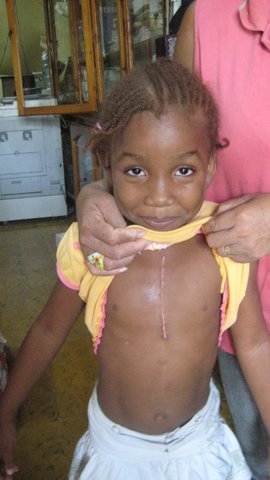
This is Kewine.
I examined Kewine for the first time in June, 2010.
Kewine was living in a tent in Carrefour, just outside of Port-au-Prince.
She was born with a Ventricular Septal Defect. This is a hole between the lower chambers of the heart that allows blood to go in the wrong direction.
Kewine was operated in the Dominican Republic in June, the hole in her heart was patched, and she is now back in Haiti.
Her mother is very happy with the results.
And so are we.
Thank you to EVERYONE involved in Kewine's care.
Saturday, July 16, 2011
When Hospital Crowding Leads to Emergency Department Overcrowding
During the last few years that I worked at OSF-Saint Francis Medical Center in Peoria, I thought that patients were not treated fairly in the Emergency Department. Patients were waiting for hours in the Emergency Department to be admitted to the hospital. We were "boarding" patients and that was dangerous for them.
I talked with Dr. Rick Miller, the Medical Director of the Emergency Department, many times during the 90's about the dysfunction in the Emergency Department. Miller was afraid of OSF-SFMC President and CEO Keith Steffen and did not adequately support the rights of his patients or his staff in the Emergency Department.
Patient and employee satisfaction in the OSF Emergency Department was the worst in the Medical Center in 2001.
The decision was made to relieve Dr. Miller of his duties as ED Medical Director in 2001 and to replace him with Dr. George Hevesy on August 1, 2001.
Dr. Hevesy was director of EMS in the Peoria area for many years and was on the salary of Advanced Medical Transport and OSF-SFMC.
I wrote a letter to Mr. Steffen in September, 2001 and told him of my concerns regarding long and dangerous boarding times in the ED. I cc'd all of my attending partners in the Emergency Department including Drs. Hevesy and Miller.
I was placed on probation the next day by Dr. Hevesy for writing the letter.
In December, 2001 while working a Prompt Care shift at OSF, Dr. Hevesy showed up and told me, while I was seeing patients, that Mr. Steffen wanted me in his office. We walked to Mr. Steffen's office. The OSF lawyer, Mr. Douglass Marshall was present, and I was fired.
What Mr. Steffen put my family through in his office at OSF during the months before he fired me has been documented on Peoria's Medical Mafia. Clearly Mr. Steffen should not be in charge of the largest Catholic hospital in downstate Illinois.
Here is a great article in the New York Times regarding why hospital crowding occurs. And this leads to dangerous ED overcrowding.
I thought this was happening at OSF-SFMC ten years ago.
Here is one paragraph from this article:
The major challenge for any patient in the emergency room is a reimbursement system that offers little incentive to decrease crowding or minimize boarding. Hospitals prefer patients who come in electively for scheduled procedures, at least from a financial perspective. For one thing, they are far more likely to be well insured than those admitted through the emergency room. By boarding E.R. patients in crowded halls, hospitals can offer the required emergency care for all while minimizing the effect on their bottom lines.
Subscribe to:
Posts (Atom)
